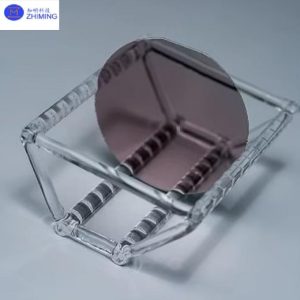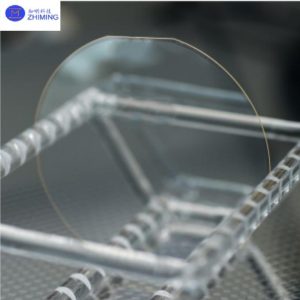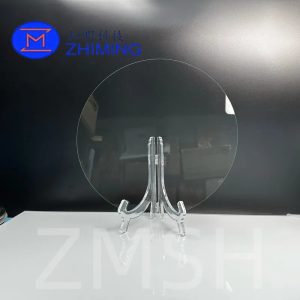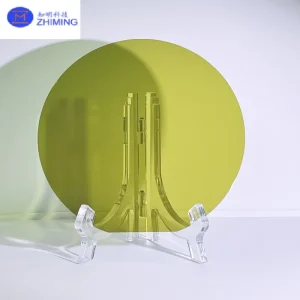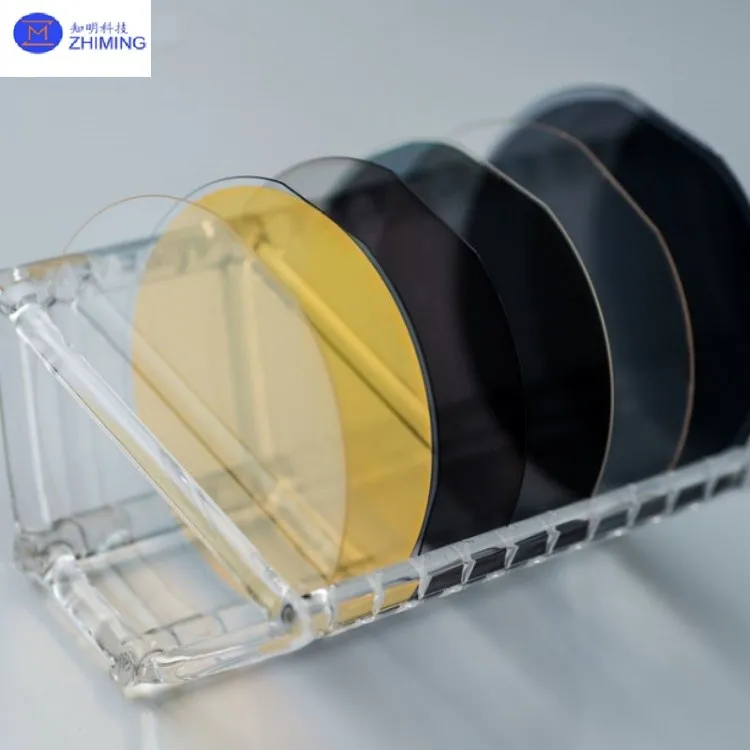
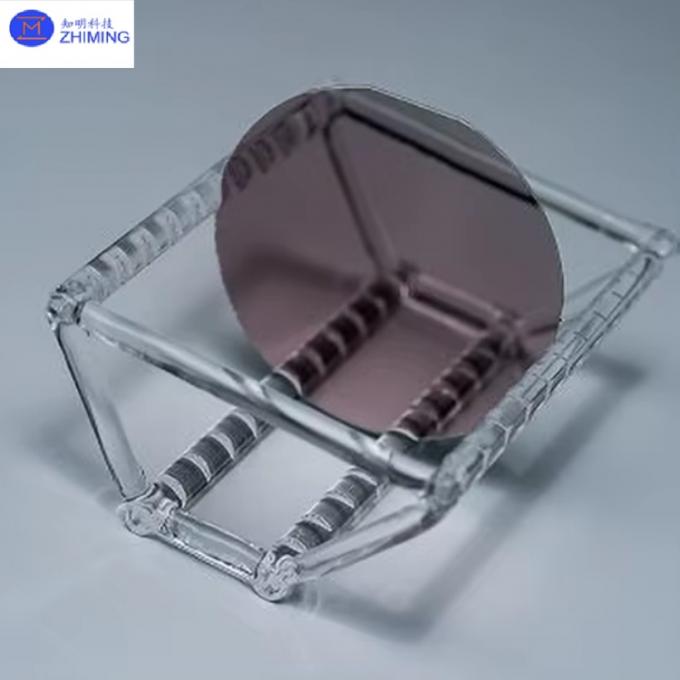
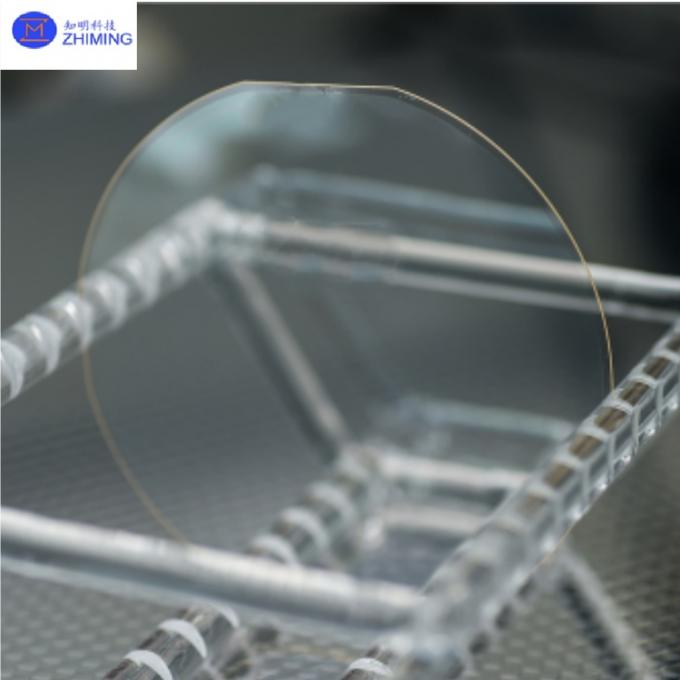
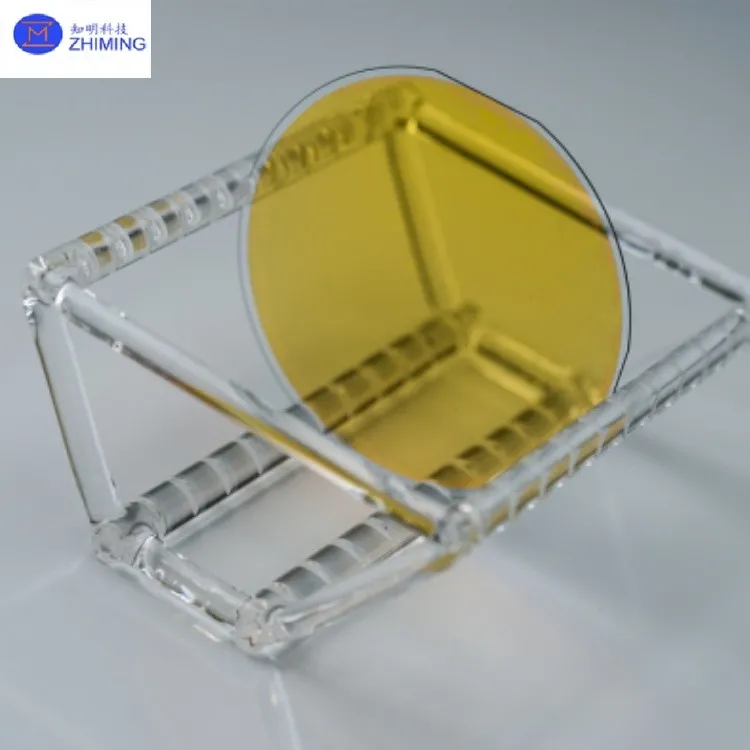
Thin-Film Lithium Niobate on Insulator (LNOI) wafers are advanced photonic substrates used for integrated optical, microwave photonic, and quantum systems.
The structure consists of a single-crystal lithium niobate thin film bonded onto a SiO₂ insulating layer and supported by a silicon substrate.
This configuration provides strong optical confinement, ultra-low propagation loss, and high electro-optic efficiency, making it a key platform for integrated photonics.
What is Thin-Film Lithium Niobate (TFLN)
Thin-Film Lithium Niobate (TFLN) refers to a sub-micron crystalline LiNbO₃ layer engineered for optical waveguide and electro-optic applications.
Compared with bulk lithium niobate, TFLN enables tighter optical confinement, smaller device footprint, and higher integration density.
TFLN is typically implemented on LNOI wafers to form a complete integrated photonic platform.
主要功能
- Ultra-low optical loss < 0.05 dB/cm @ 1550 nm
- High electro-optic coefficient (r₃₃ up to 90 pm/V)
- Sub-micron waveguide compatibility (<1 μm)
- CMOS-compatible integration with Si / SiN platforms
- High thermal stability (~1140°C Curie temperature)
- Multiple crystal cuts: X-cut / Y-cut / Z-cut
- Wafer sizes: 3 inch / 4 inch / 6 inch / 8 inch
Wafer Structure
| Layer | 材質 | Function |
|---|---|---|
| Top Layer | LiNbO₃ Thin Film (TFLN) | Electro-optic & nonlinear optical functionality |
| Middle Layer | SiO₂ (Buried Oxide) | Optical isolation & confinement |
| Bottom Layer | Si / Quartz / Sapphire | Mechanical support & CMOS compatibility |
技術規格
Wafer Specifications
| 參數 | 價值 |
|---|---|
| Wafer Diameter | 3″, 4″, 6″, 8″ |
| Total Thickness | 525 ± 25 μm |
| 弓形 | ±50 μm |
| 翹曲 | <50 μm |
| LTV | <1.5 μm (5×5 mm², 95%) |
Thin-Film Lithium Niobate Layer
| 參數 | 價值 |
|---|---|
| 材質 | Single-crystal LiNbO₃ |
| 厚度 | 300 nm – 1000 nm |
| Orientation Accuracy | ±0.5° |
| 表面粗糙度 | Ra < 1 nm |
| Bonding Defects | No defects >1 mm |
Buried Oxide Layer (SiO₂)
| 參數 | 價值 |
|---|---|
| 材質 | SiO₂ |
| 厚度 | 100 nm – 2 μm (customizable) |
| 均一性 | ±5% |
Fabrication Process
LNOI wafers are manufactured using semiconductor-grade processes:
- Ion implantation for controlled layer separation
- Wafer bonding onto insulating substrates
- High-temperature annealing for crystal stabilization
- Chemical Mechanical Polishing (CMP) for surface planarization
- Final optical and structural quality inspection
Key Applications
- High-speed optical communication (100G–800G modulators)
- Quantum photonics (entangled photon generation, QKD systems)
- Microwave photonics (RF signal processing, mmWave systems)
- Nonlinear optics (frequency conversion, optical combs)
- Integrated sensing systems (biochemical and optical resonators)
Performance Advantage vs Bulk LiNbO₃
| 財產 | Bulk LiNbO₃ | LNOI Thin Film |
|---|---|---|
| Optical Loss | Higher | <0.05 dB/cm |
| Integration | 低 | High-density photonics |
| Device Size | Large | Sub-micron scale |
| CMOS Compatibility | No | Yes |
| Modulation Efficiency | 中度 | High (Vπ ~1V achievable) |
客製化選項
| Option | 說明 |
|---|---|
| Crystal Cut | X-cut / Y-cut / Z-cut |
| 薄膜厚度 | 300 nm – 1000 nm |
| Substrate | Si / Quartz / Sapphire |
| Oxide Layer | 100 nm – 2 μm (custom) |
| Doping | MgO-doped LiNbO₃ available |
品質控制
| Test Item | 方法 |
|---|---|
| Optical Loss | Waveguide propagation test |
| 表面粗糙度 | AFM measurement |
| 厚度均勻性 | Mapping system |
| Bonding Quality | IR inspection |
| 平整度 | Wafer metrology |
Engineering Capability
ZMSH provides full-process support for LNOI wafer development:
- Thin-film design optimization
- Wafer bonding process engineering
- Photonic device fabrication support
- Nanofabrication (EBL / IBE)
- Optical performance testing and validation
Supports both R&D prototyping and scalable small-batch production up to 8-inch wafers.
常見問題
What is LNOI used for
LNOI wafers are widely used in optical communication, quantum photonics, nonlinear optics, and integrated photonic circuits.
What is the typical thin-film thickness
Typical lithium niobate thin-film thickness ranges from 300 nm to 1000 nm.
Why use LNOI instead of bulk lithium niobate
LNOI offers lower optical loss, higher integration density, and CMOS-compatible photonic integration.
Can LNOI integrate with silicon photonics
Yes, LNOI is fully compatible with silicon and silicon nitride photonic platforms.


商品評價
目前沒有評價。