
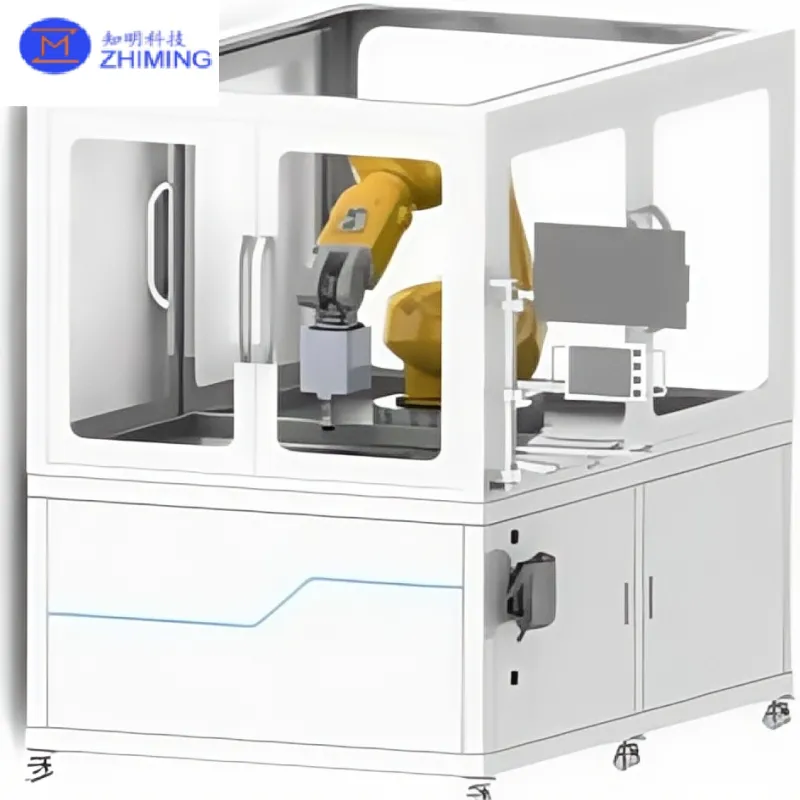
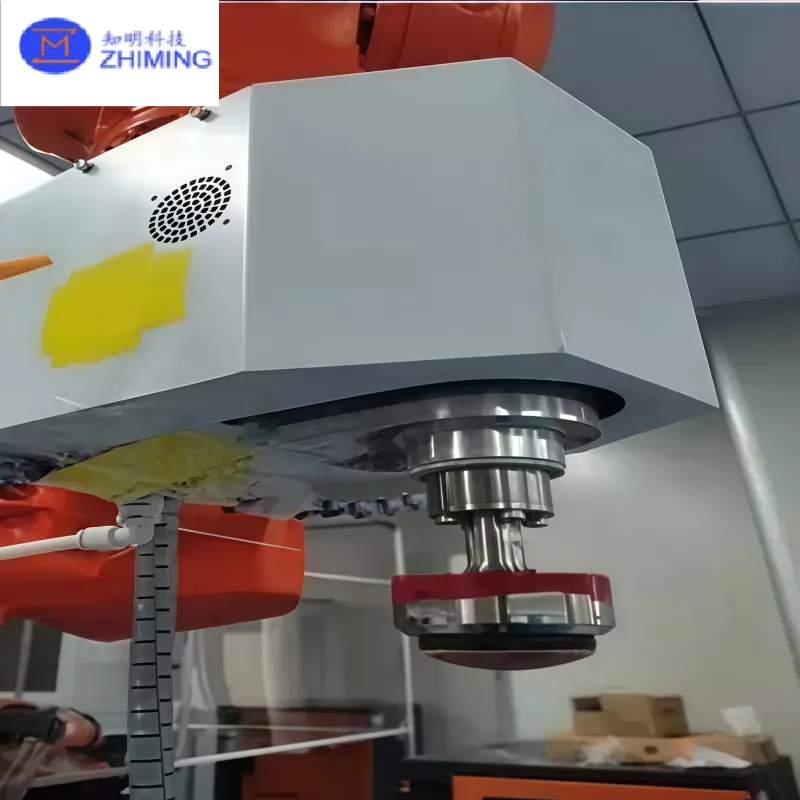
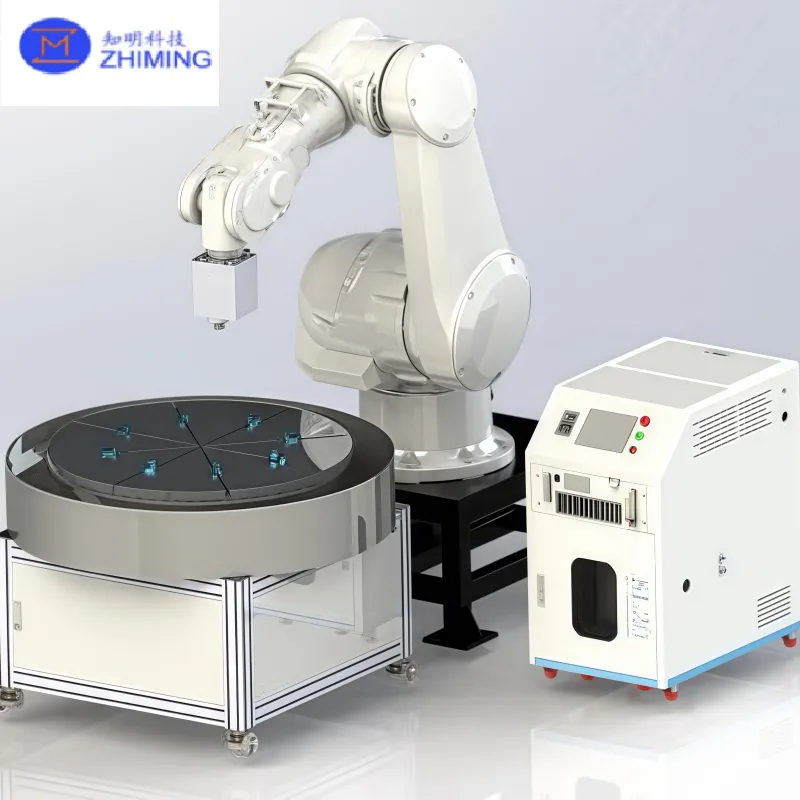
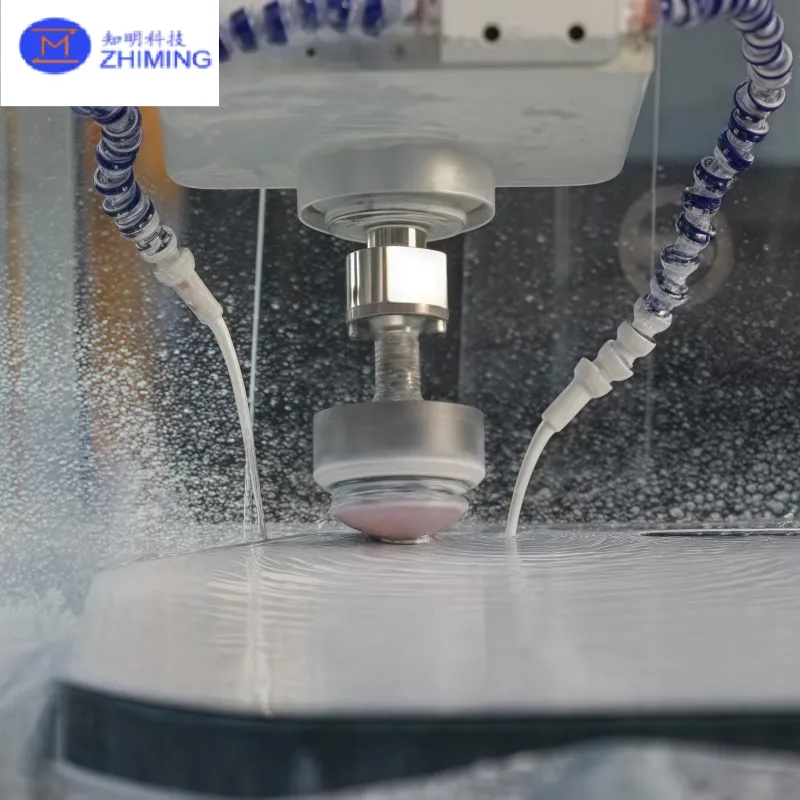
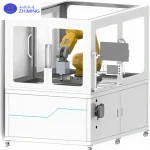
 The Robot Polishing Machine is a high-precision automated system designed for polishing large-scale and complex optical surfaces. It integrates a 6-axis industrial robot platform (such as KUKA, ABB, or Stäubli) with advanced polishing modules and intelligent control software.
This system enables fully digital optical fabrication, covering the entire workflow from surface modeling and tool path generation to real-time force control and process monitoring. Compared with traditional manual polishing, it delivers higher consistency, improved efficiency, and superior surface accuracy.
Key Technical Parameters
| Parameter | Specification |
|---|---|
| Repeat Positioning Accuracy | ±0.04 mm / ±0.05 mm / ±0.10 mm |
| Processing Diameter | Φ50 – Φ2000 mm |
| Polishing Head Types | Airbag / Rigid / Wheel / Combined |
| Spindle Speed | Up to 1500 rpm |
| Continuous Operation | ≥300 hours |
| Optional Features | Auto-calibration, Online Monitoring, NC Rotary Table |
Working Principle
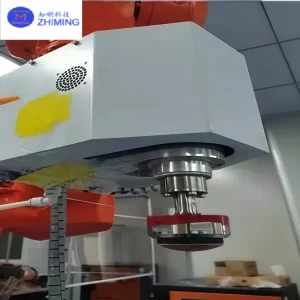
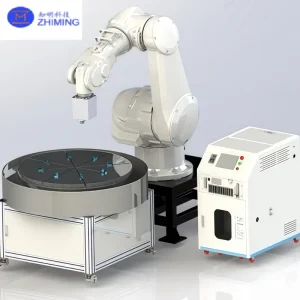
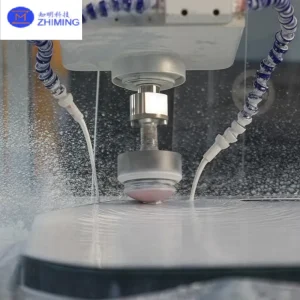
1. Six-Axis Coordinated Motion
The machine utilizes full 6-axis robotic motion to achieve uniform coverage of complex geometries, including freeform and off-axis surfaces.
2. Constant Force Control System
An integrated electronic pressure cylinder ensures stable and adaptive polishing force, preventing over-polishing or surface damage.
3. Adaptive Rotary Axis
The adjustable spindle automatically aligns with surface curvature, enabling precision processing of spheres, aspheres, and freeform optics.
4. Closed-Loop Sensor Feedback
Real-time monitoring through force and position sensors ensures process stability and repeatability.
5. Optical Software Integration
Advanced software supports 3D modeling, simulation, path optimization, and data analysis, forming a complete intelligent polishing solution.
Core Features
- High Precision Control
Achieves optical-grade surface accuracy with RMS < 10 nm - Flexible Tooling System
Supports multiple polishing heads with quick-change capability - Fully Automated Workflow
From modeling to inspection, all processes are digitally integrated - Long-Term Stability
Continuous operation up to 300+ hours - Smart Monitoring System
Real-time diagnostics and adaptive control ensure safe operation
Application Industries
Optics
- Telescope mirrors
- High-power laser optics
- Precision optical components
Aerospace
- Satellite imaging systems
- Remote sensing optics
Precision Manufacturing
- Semiconductor optical components
- Ultra-precision molds
Automotive
- Headlamp molds
- Decorative high-gloss components
Typical Models
| Model | Robot Base | Accuracy | Diameter Range |
|---|---|---|---|
| IRP500S | Stäubli TX2-90L | ±0.04 mm | Φ50–Φ500 mm |
| IRP1000S | Stäubli TX200/L | ±0.05 mm | Φ80–Φ1000 mm |
| IRP2000A | ABB IRB6700 | ±0.10 mm | Φ200–Φ2000 mm |
Key Advantages
- Ultra-High Surface Quality
Optical surfaces with nanometer-level precision - High Efficiency Production
Multi-axis automation significantly reduces processing time - Wide Compatibility
Suitable for various materials and complex geometries - Reduced Labor Cost
Replaces manual polishing with automated systems - Scalable Manufacturing
Suitable for both R&D and mass production
FAQ
Q1: What types of surfaces can be processed?
A: Flat, spherical, aspherical, off-axis aspherical, and freeform surfaces.
Q2: What surface accuracy can be achieved?
A: RMS < 10 nm, meeting high-end optical standards.
Q3: Is the system suitable for large optics?
A: Yes, it supports diameters up to 2000 mm.
Q4: Does it support different polishing tools?
A: Yes, including airbag, rigid, and wheel-type polishing heads.
Q5: Which industries benefit most?
A: Optics, aerospace, semiconductor manufacturing, and automotive.
Request a Quote for CNC Robot Polishing Machine for Large Optical Surfaces
Tell us your required specifications, dimensions, quantity, application and technical requirements. You can also provide drawings or additional project information. Our technical team will review your requirements and reply as soon as possible.

Reviews
There are no reviews yet.