


The 6-inch 4H-N Silicon Carbide wafer is a wide bandgap semiconductor substrate designed for next-generation power electronic devices. Compared with traditional silicon materials, SiC offers significantly higher breakdown electric field strength, superior thermal conductivity, and stable performance under high temperature and high voltage conditions.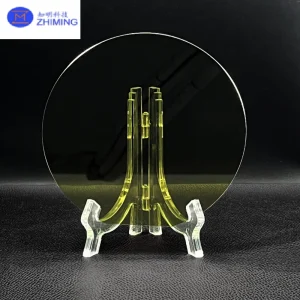
The wide bandgap of approximately 3.26 eV enables SiC-based devices to operate at higher voltages and switching frequencies while maintaining lower energy losses. As a result, SiC has become a key material for high-efficiency power conversion systems, including electric vehicles, renewable energy systems, and industrial power supplies.
The 6-inch (150 mm class) wafer format is currently the mainstream industrial standard for SiC device manufacturing. It provides an optimal balance between production yield, process maturity, and cost efficiency, making it suitable for both mass production and advanced research applications.
Material Properties
4H-SiC is the most widely used polytype in power electronics due to its favorable crystal symmetry and electrical performance.
Key intrinsic properties include:
- Wide bandgap (~3.26 eV) enabling high-voltage operation
- High thermal conductivity (~4.9 W/cm·K) for efficient heat dissipation
- High breakdown electric field (~3 MV/cm) allowing compact device design
- High electron saturation velocity supporting fast switching
- Excellent chemical and radiation resistance for harsh environments
These properties make SiC a critical material for high-power, high-efficiency semiconductor devices.
 Crystal Growth and Manufacturing Process
SiC wafers are typically manufactured using the Physical Vapor Transport (PVT) method, a mature industrial process for bulk SiC crystal growth.
In this process, high-purity SiC powder is sublimated at temperatures above 2000°C. The vapor-phase species are transported under carefully controlled thermal gradients and recrystallized on a seed crystal, forming a single-crystal boule.
After crystal growth, the material undergoes:
- Precision slicing into wafers
- Edge shaping and lapping
- Chemical mechanical polishing (CMP)
- Cleaning and defect inspection
For device fabrication, an additional Chemical Vapor Deposition (CVD) epitaxial process can be applied to form high-quality epitaxial layers with controlled doping concentration and thickness.
Applications
Power Electronics Devices
- SiC MOSFETs for high-efficiency switching systems
- SiC Schottky Barrier Diodes (SBDs) for low-loss rectification
- DC-DC and AC-DC power converters
- Industrial motor drives and inverters
Electric Vehicles and Energy Systems
- On-board chargers (OBC)
- Traction inverters
- Fast charging systems
- Renewable energy inverters (solar / wind)
Harsh Environment Applications
- Aerospace electronics
- High-temperature industrial systems
- Oil & gas exploration electronics
- Radiation-resistant electronics
Emerging System-Level Applications
- Compact power modules for optoelectronic systems
- Microdisplay driver circuits (low-power design integration)
Technical Specifications
6-Inch 4H-SiC Wafer Specification Table
| Property | Z Grade (Production Grade) | D Grade (Engineering Grade) |
|---|---|---|
| Diameter | 149.5 – 150.0 mm | 149.5 – 150.0 mm |
| Polytype | 4H-SiC | 4H-SiC |
| Thickness | 350 ± 15 µm | 350 ± 25 µm |
| Conductivity Type | N-type | N-type |
| Off-axis Angle | 4.0° toward <11-20> ± 0.5° | 4.0° toward <11-20> ± 0.5° |
| Resistivity | 0.015 – 0.024 Ω·cm | 0.015 – 0.028 Ω·cm |
| Micropipe Density | ≤ 0.2 cm⁻² | ≤ 15 cm⁻² |
| Surface Roughness (Ra) | ≤ 1 nm | ≤ 1 nm |
| CMP Roughness | ≤ 0.2 nm | ≤ 0.5 nm |
| LTV | ≤ 2.5 µm | ≤ 5 µm |
| TTV | ≤ 6 µm | ≤ 15 µm |
| Bow | ≤ 25 µm | ≤ 40 µm |
| Warp | ≤ 35 µm | ≤ 60 µm |
| Edge Exclusion | 3 mm | 3 mm |
| Packaging | Cassette / Single wafer | Cassette / Single wafer |
 Quality Control & Inspection
To ensure consistency and device compatibility, each wafer is subjected to strict quality control processes, including:
- X-ray Diffraction (XRD) for crystal structure evaluation
- Atomic Force Microscopy (AFM) for surface roughness measurement
- Photoluminescence (PL) mapping for defect distribution analysis
- Optical inspection under high-intensity illumination
- Geometric inspection (bow, warp, thickness variation)
These inspections ensure wafer stability for downstream epitaxial growth and device fabrication.
Advantages
The 6-inch SiC wafer platform offers several key advantages:
- Industrial-standard wafer size for mass production
- Reduced cost per device due to higher wafer utilization
- High compatibility with epitaxial and device processes
- Low defect density (optimized for power device yield)
- Stable electrical and thermal performance
- Suitable for both R&D and large-scale manufacturing
Customization Options
We support flexible customization based on application requirements:
- N-type / semi-insulating substrates
- Adjustable dopant concentration
- Custom off-axis angles
- Epi-ready surface preparation
- Defect density grading (research vs production grade)
- Thickness and resistivity customization
FAQ
Q1: Why is 4H-SiC preferred over other SiC polytypes such as 6H-SiC?
4H-SiC offers higher electron mobility and lower on-resistance compared with 6H-SiC, making it more suitable for high-frequency and high-power switching applications. It also provides better overall performance stability in MOSFET and power diode devices, which is why it has become the dominant polytype in commercial power electronics.
Q2: What is the purpose of the off-axis angle in SiC wafers?
The off-axis angle (typically 4° toward <11-20>) is introduced to improve epitaxial layer quality during CVD growth. It helps suppress surface defects such as step bunching and promotes step-flow growth mode, resulting in better crystal uniformity and higher device yield in epitaxial structures.
Q3: What factors most influence SiC wafer quality for device manufacturing?
Key factors include micropipe density, basal plane dislocation (BPD) levels, surface roughness (Ra and CMP quality), and wafer bow/warp. Among these, defect density and surface quality have the most direct impact on MOSFET reliability and long-term device performance.

Reviews
There are no reviews yet.