
Silicon carbide (SiC) is a high-performance ceramic widely used in semiconductor processing, optics, and harsh industrial environments. Among its various forms, CVD Silicon Carbide (CVD SiC)—produced via Chemical Vapor Deposition—is often regarded as one of the most advanced ceramic materials due to its exceptional purity, density, and structural uniformity.
This article examines the material properties, microstructure, and application advantages of CVD SiC, supported by comparative data with other commonly used materials.
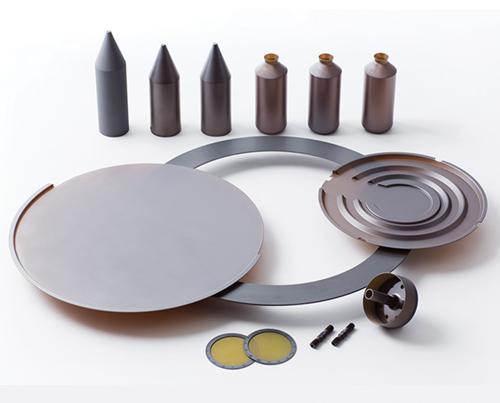
1. Material Properties: A Comparative Perspective
Based on typical engineering data, CVD SiC demonstrates superior performance across multiple key parameters:
Table 1. Typical Material Properties Comparison
| Material | Density (g/cm³) | Thermal Conductivity (W/m·K) | Specific Heat (J/kg·K) | Elastic Modulus (GPa) | CTE (×10⁻⁶ /K) | Surface Finish |
|---|---|---|---|---|---|---|
| Beryllium (Be) | ~1.85 | ~216 | ~1880 | ~303 | ~11.4 | ≤10 Å RMS |
| ULE Glass | ~2.20 | ~1.30 | ~708 | ~67 | ~0.03 | ≤3 Å RMS |
| Polycrystalline SiC | ~2.30 | ~150 | ~920 | ~110 | ~3.8 | ≤5 Å RMS |
| Quartz | ~2.20 | ~1.40 | ~1210 | ~70 | ~0.5 | ≤3 Å RMS |
| CVD SiC | ~3.21 | ~300 | ~640 | ~466 | ~4.0 | ≤3 Å RMS |
| Reaction-Bonded SiC | ~3.10 | 120–170 | — | ~391 | ~4.3 | ≥20 Å RMS |
| Hot-Pressed SiC | ~3.20 | 50–120 | — | ~451 | ~4.6 | ≥50 Å RMS |
| Sintered SiC | ~3.10 | 50–120 | — | ~408 | ~4.5 | ≥100 Å RMS |
Key Observations
1. High Thermal Conductivity
CVD SiC (~300 W/m·K) significantly outperforms quartz and glass materials.
Implication:
Efficient heat dissipation and reduced thermal gradients in high-temperature systems.
2. High Elastic Modulus
With values exceeding 450 GPa, CVD SiC offers exceptional stiffness.
Implication:
Maintains dimensional stability under thermal and mechanical stress.
3. Low Thermal Expansion
A relatively low coefficient of thermal expansion (CTE) ensures minimal deformation.
Implication:
Critical for precision applications such as semiconductor processing and optics.
4. Ultra-Smooth Surface Finish
Surface roughness can reach angstrom-level (≤3 Å RMS).
Implication:
Minimizes particle contamination in ultra-clean environments.
2. Microstructure: The Advantage of CVD Processing
CVD SiC is formed through gas-phase reactions, resulting in a fully dense, pore-free solid.
Key Structural Features:
- Purity up to ~99.999%
- Near-theoretical density
- No grain boundary secondary phases
- Cubic β-SiC crystal structure (isotropic behavior)
Scientific Significance:
Unlike powder-based ceramics, CVD SiC lacks internal defects such as pores or residual binders, which are common in sintered materials. This leads to:
- Improved chemical stability
- Reduced particle generation
- Enhanced reproducibility
3. Performance in Harsh Environments
3.1 High-Temperature Stability
CVD SiC components can operate in environments exceeding 1500°C, maintaining structural integrity and performance.
3.2 Chemical Resistance
- Resistant to aggressive chemicals
- Can be cleaned using strong acids such as HF and HCl with minimal degradation
Implication:
Suitable for repeated use in chemically harsh processing environments.
3.3 Low Particle Generation
Due to the absence of grain boundary phases:
- Fewer particles are generated during operation
- Lower contamination risk in sensitive processes
4. Application in Semiconductor Processing
CVD SiC is widely used in semiconductor manufacturing equipment, including:
- Rapid Thermal Processing (RTP) rings and susceptors
- Epitaxy (Epi) components
- Plasma etching chamber parts
Why It Is Preferred:
- High purity requirements (>99.999%)
- High-temperature operation (>1500°C)
- Strong resistance to plasma and chemical corrosion
Additionally, materials with controlled resistivity are used in RF-coupled systems, enabling compatibility with different electrical environments.
5. Comparison with Sintered Silicon Carbide
While many SiC components are produced via sintering or hot pressing, these methods introduce:
- Grain boundaries
- Residual phases
- Porosity
These structural features can:
- Reduce oxidation resistance at high temperatures
- Increase particle generation
- Limit performance in ultra-clean environments
Conclusion:
CVD SiC is generally more suitable for high-purity, high-temperature, and contamination-sensitive applications, while sintered SiC remains effective for structural and cost-sensitive uses.
6. Conclusion
CVD Silicon Carbide represents a near-ideal ceramic material in terms of purity, density, and performance consistency. Its advantages stem directly from its unique deposition-based fabrication process, which eliminates many of the structural limitations found in conventional ceramics.
As advanced technologies continue to demand:
- Higher cleanliness
- Greater thermal stability
- Improved material reliability
CVD SiC is expected to remain a critical material in high-end engineering applications.