
When most people think of quartz glass, they imagine a transparent material used for optical windows, semiconductor furnace tubes, quartz rods, laboratory glassware, and high-purity process components.
However, quartz glass does not always have to be transparent.
A specialized category known as black quartz glass has attracted increasing attention in semiconductor equipment, infrared thermal management, optical shielding, analytical instruments, and advanced industrial applications.
Unlike conventional transparent fused quartz, black quartz is engineered to strongly absorb or block selected wavelengths of light while maintaining many of the desirable characteristics of silica glass, including relatively low thermal expansion, good chemical stability, electrical insulation, and compatibility with precision fabrication.
Its most important advantage is not simply higher temperature resistance.
Instead, black quartz creates new possibilities for controlling light and thermal radiation inside high-temperature process equipment.
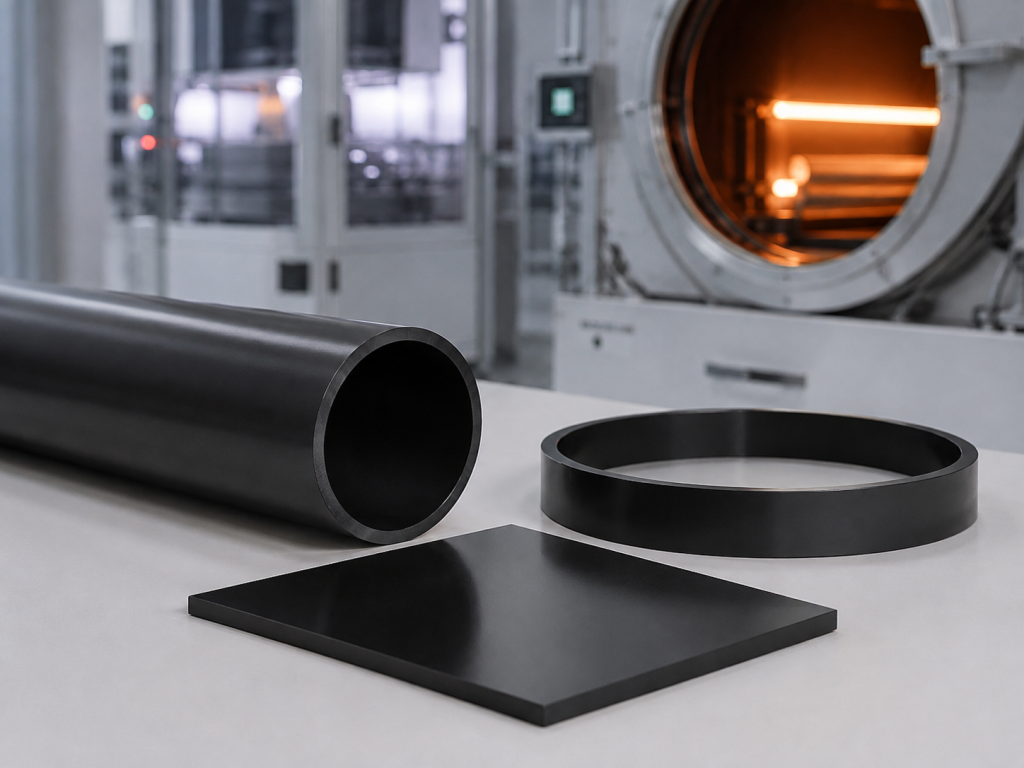
What Is Black Quartz Glass?
Black quartz glass is a modified silica-based material designed to exhibit strong optical absorption and low light transmission.
Depending on the manufacturing technology, the black appearance may be produced through:
- Controlled incorporation of silicon-containing phases
- Special dopants
- Microscopic absorbing particles
- Controlled microstructures
- Surface modification
- Laser texturing
This means that “black quartz” is not a single universal composition.
Different manufacturers and material grades may have significantly different:
- Purity levels
- Optical absorption
- Infrared emissivity
- Thermal conductivity
- Working temperature
- 孔隙率
- Mechanical properties
- Semiconductor compatibility
For semiconductor and optical applications, the exact material grade should therefore be selected according to the process environment rather than color alone.
Research has also demonstrated that quartz surfaces can be engineered through femtosecond-laser texturing to substantially reduce infrared transmission by creating light-trapping surface structures.
1. High Optical Absorption and Excellent Light Shielding
The most obvious difference between black quartz and conventional clear fused quartz is optical behavior.
High-quality transparent fused silica is designed to transmit light over a broad wavelength range. Depending on material grade, it can offer excellent transmission from the ultraviolet into the near-infrared region.
Black quartz is engineered for almost the opposite purpose.
Its internal structure or composition absorbs a significant portion of incoming optical radiation, producing a dark or opaque appearance.
This makes it useful where unwanted light must be blocked.
Typical applications can include:
- Optical shielding
- Stray-light suppression
- Laser system components
- Infrared thermal components
- Semiconductor equipment shields
- Optical analysis cells
- Sensor housings
- High-temperature light barriers
Instead of allowing radiation to pass through the component, black quartz can absorb more of that energy.
2. High Infrared Emissivity for Thermal Management
One of the most valuable properties of certain black quartz grades is their relatively high infrared emissivity.
For example, one commercial electric-fused black quartz grade reports emissivity above 80% in the 10–20 μm infrared range.
This characteristic can be particularly useful in semiconductor thermal processing.
Inside high-temperature process equipment, heat transfer occurs not only through conduction and convection but also through thermal radiation.
Transparent quartz allows a considerable amount of radiation to pass through certain wavelength ranges.
Black quartz, by contrast, can absorb and re-radiate thermal energy.
This may allow equipment designers to better control:
- Radiative heat distribution
- Heat loss to surrounding components
- Local temperature gradients
- Thermal shielding
- Heater efficiency
- Process chamber temperature uniformity
For this reason, black quartz can function as a thermal radiation management material, rather than simply as a structural quartz component.
3. Can Black Quartz Improve Heating Efficiency?
In certain applications, yes.
Because black quartz can absorb more infrared radiation than conventional transparent quartz, it may convert incoming radiant energy into heat more effectively.
This can be useful in infrared heating systems where the objective is to:
- Capture radiant energy
- Reduce unwanted transmission
- Redistribute thermal radiation
- Improve local heating
- Shield surrounding components
However, the actual energy-saving effect depends heavily on system design.
Black quartz should therefore not automatically be described as an “energy-saving material.”
The benefit must be evaluated together with:
heater wavelength + component geometry + emissivity + chamber temperature + thermal insulation + process conditions.
4. Does Black Quartz Withstand Higher Temperatures Than Clear Quartz?
This point requires careful explanation.
It is sometimes claimed that black quartz has a softening temperature of 1650–2000°C and is therefore dramatically more heat-resistant than transparent fused quartz.
This is not universally correct.
Black quartz is available in different compositions and manufacturing grades, and its working-temperature limit depends on the specific material.
For example, one published black quartz grade specifies:
- Continuous working temperature: approximately 1150°C
- Short-term working temperature: approximately 1300°C
Meanwhile, conventional fused silica typically has a softening region around 1500–1600°C, while practical continuous service temperatures are usually much lower and depend on mechanical load and operating conditions.
Therefore:
Black quartz should not automatically be considered more temperature-resistant than clear fused quartz.
Its primary advantage lies in its optical and thermal-radiation properties.
For engineering selection, users should distinguish between:
- Softening temperature
- Annealing temperature
- Continuous operating temperature
- Short-term operating temperature
- Temperature under mechanical load
These are not the same specification.
5. Low Thermal Expansion
Like conventional fused silica, many black quartz materials retain the low thermal expansion associated with the silica glass network.
For reference, conventional fused silica typically has a thermal expansion coefficient of around:
0.55 × 10⁻⁶/K
at room temperature.
One commercial black quartz grade reports approximately:
0.60 × 10⁻⁶/°C
over its specified temperature range.
This low thermal expansion provides several advantages:
- 出色的尺寸穩定性
- 降低熱應力
- Good resistance to thermal cycling
- Lower risk of deformation
- Stable alignment in precision equipment
This is particularly important for semiconductor equipment where dimensional changes at elevated temperatures can influence process uniformity.
6. Low Thermal Conductivity
Quartz glass is naturally a relatively poor thermal conductor compared with metals.
Typical fused silica has a room-temperature thermal conductivity of approximately:
1.3–1.4 W/(m·K)
although actual values vary with grade and temperature.
One commercial black quartz material reports approximately:
1.65 W/(m·K) at 20°C.
Therefore, it would be inaccurate to state that black quartz always has lower thermal conductivity than transparent quartz.
A better way to describe its advantage is that black quartz combines:
relatively low conductive heat transfer + strong radiative absorption/emission.
This combination gives equipment designers additional control over how heat is distributed within a thermal system.
7. High Purity for Semiconductor Applications
Blackening a quartz material is relatively easy if purity does not matter.
Producing high-purity black quartz suitable for semiconductor equipment is much more difficult.
Conventional pigments used in ordinary glass may introduce unwanted elements such as:
- Iron
- Chromium
- Nickel
- Sodium
- Potassium
- Copper
These contaminants may be unacceptable in semiconductor processing environments.
Advanced black quartz materials are therefore engineered to provide optical absorption while maintaining low metallic impurity levels.
Certain synthetic black quartz technologies use silicon and silicon monoxide phases within a silica matrix rather than conventional colored-glass pigments. Such materials have been specifically developed for semiconductor equipment, infrared heat-absorbing components, and optical shielding applications.
For semiconductor use, customers should always request an impurity specification rather than relying only on nominal SiO₂ purity.
8. Chemical Stability
Black quartz can retain many of the chemical characteristics associated with silica glass.
Depending on its composition and manufacturing process, it can provide good resistance to many:
- Acids
- Oxidizing environments
- Process gases
- High-temperature atmospheres
This can make it suitable for selected semiconductor process environments where both chemical stability and optical shielding are required.
However, black quartz is still fundamentally a silica-based material.
It is therefore important to remember that hydrofluoric acid and fluoride-containing chemistries attack SiO₂.
Strong alkaline environments can also attack quartz at elevated temperatures.
Chemical compatibility should always be checked against:
- Process chemistry
- Gas composition
- Plasma chemistry
- 溫度
- Exposure duration
Black Quartz vs. Transparent Fused Quartz
| 財產 | Transparent Fused Quartz | Black Quartz |
|---|---|---|
| Appearance | Transparent | Black / opaque |
| Visible-light transmission | 高 | Very low |
| Infrared transmission | Grade-dependent | Strongly reduced in designed ranges |
| Optical absorption | Low in transmission window | 高 |
| Infrared emissivity | Relatively lower | Can be significantly higher |
| Thermal expansion | Very low | Very low for many grades |
| Thermal conductivity | 低 | Low, grade-dependent |
| 化學穩定性 | Excellent for many environments | Similar in many grades |
| Semiconductor purity | Excellent grades available | Depends strongly on blackening technology |
| Thermal radiation control | 有限責任 | 極佳 |
| Stray-light suppression | Poor | 極佳 |
| Main role | Transmission / isolation | Absorption / shielding / thermal management |
The two materials should therefore be considered complementary rather than competing materials.
Why Is Black Quartz Important in Semiconductor Manufacturing?
Modern semiconductor equipment requires increasingly precise control of:
- Wafer temperature
- Chamber temperature
- Heater radiation
- Optical interference
- Plasma environment
- 粒子生成
- Metal contamination
As process windows become narrower, even small changes in thermal distribution can influence process repeatability.
Black quartz provides equipment engineers with an additional design tool.
Instead of merely supporting or isolating components, quartz can also participate actively in radiative thermal management.
9. Semiconductor Thermal Processing
Black quartz may be used in selected high-temperature semiconductor equipment as:
- Thermal shields
- Heater-adjacent components
- Radiation-absorbing plates
- Process chamber components
- Heat-distribution structures
- Light-blocking components
High infrared absorption and emissivity can help manage how radiant heat moves through the chamber.
This may be valuable in processes requiring high thermal uniformity.
10. Plasma and Etch Equipment
Special black synthetic quartz grades have also been developed for selected semiconductor plasma equipment and etching-related components.
Patented black quartz materials have specifically identified applications including plasma-etch-resistant members, infrared heat-absorbing components, and light-shielding members for semiconductor manufacturing equipment.
However, plasma compatibility depends strongly on:
- Fluorine concentration
- Plasma energy
- 溫度
- 表面狀況
- Material composition
Therefore, plasma applications require qualification of the specific quartz grade.
11. Infrared Heating Systems
Black quartz is particularly well suited to infrared thermal systems.
Potential applications include:
- Infrared heater components
- Heat shields
- Radiation absorbers
- Thermal barriers
- High-temperature laboratory equipment
By controlling which surfaces transmit, absorb, and emit infrared radiation, designers can create more precisely controlled thermal environments.
12. Optical and Laser Systems
Another major application area is optical shielding.
Transparent quartz is excellent when light transmission is desired.
Black quartz is useful when light transmission is undesirable.
Applications may include:
- Laser shielding components
- Optical apertures
- Sensor housings
- Spectroscopy cells
- Stray-light suppression structures
- Optical instrument components
A black quartz component can maintain quartz-compatible thermal and chemical properties while significantly reducing unwanted optical transmission.
13. Analytical and Scientific Instruments
Black quartz can also be used in analytical equipment where stray light interferes with detector performance.
For example, black quartz structures can help isolate optical paths in:
- Spectrometers
- Photodetectors
- Infrared instruments
- Optical measurement systems
Its combination of low contamination, dimensional stability, and optical absorption can be particularly useful in precision instruments.
Black quartz can be produced using several technical approaches.
Controlled Doping
Specific compounds or silicon-containing phases can be introduced into the silica structure to increase optical absorption.
The challenge is maintaining high chemical purity.
Silicon / Silicon Oxide Incorporation
Some synthetic black quartz technologies incorporate elemental silicon and silicon monoxide particles into the SiO₂ glass matrix.
These phases can create strong light shielding while avoiding some of the metallic contaminants associated with conventional glass pigments.
Controlled Microstructure
Certain manufacturing processes create microscopic structures that enhance absorption and scattering.
These structures can dramatically reduce optical transmission.
Laser Surface Texturing
More recent research has investigated femtosecond-laser processing to create microscopic craters or grooves on quartz surfaces.
These structures trap incoming light through repeated internal reflection, increasing absorption and reducing transmission.
Recent experimental work has demonstrated infrared transmittance reductions of up to approximately 60% for selected textured quartz structures.
This approach may open additional opportunities for functional quartz surfaces without relying entirely on bulk-material doping.
What Should Buyers Specify When Ordering Black Quartz?
Black quartz cannot be purchased correctly by simply specifying:
“black quartz plate.”
For industrial applications, buyers should define the actual performance requirements.
重要規格包括:
Material Composition
Specify whether the material is:
- Fused black quartz
- Synthetic black quartz
- Doped fused silica
- Surface-blackened quartz
純淨
For semiconductor applications, request impurity data for elements such as:
- Al
- Fe
- Na
- K
- Li
- Ca
- Cu
- Ni
Optical Properties
Important parameters may include:
- Visible transmittance
- UV transmittance
- NIR transmittance
- IR absorption
- Emissivity
- Target wavelength range
A black appearance alone does not define optical performance.
Operating Temperature
Specify:
- Continuous temperature
- Maximum short-term temperature
- Thermal cycling conditions
Do not rely only on softening-point data.
尺寸
Provide:
- Diameter or length × width
- 厚度
- 尺寸公差
- 平整度
- 表面處理
Application Environment
Indicate whether the component will operate in:
- Air
- 真空
- Nitrogen
- Argon
- Plasma
- Semiconductor process gas
- Infrared heating equipment
This helps determine whether the material is chemically and thermally compatible.
Future Development of Black Quartz
Black quartz is part of a broader trend toward functional quartz materials.
Traditional quartz components primarily provide passive functions such as:
- Structural support
- 光傳輸
- Electrical insulation
- Chemical isolation
Future quartz materials are increasingly being engineered to perform additional functions, including:
- Selective optical absorption
- Thermal radiation control
- Light shielding
- Surface functionalization
- Plasma resistance
- Precision thermal management
Advances in doping, synthetic quartz production, microstructure control, and laser surface engineering may further expand the performance range of these materials.
Potential applications may grow in:
- Advanced semiconductor equipment
- Infrared systems
- High-temperature sensors
- 光子學
- Precision scientific instruments
- Aerospace thermal management
- Next-generation optoelectronic systems
Rather than simply replacing transparent quartz, black quartz represents a specialized extension of the quartz material family.
總結
Black quartz glass demonstrates how a familiar material can acquire entirely new functions through materials engineering.
Its key advantages are not simply that it is black or that it can withstand high temperatures.
The real value lies in the combination of:
high optical absorption + high infrared emissivity + low thermal expansion + low thermal conductivity + chemical stability + precision quartz fabrication.
These characteristics make black quartz particularly attractive for semiconductor thermal management, infrared heating, optical shielding, analytical instruments, and other advanced equipment.
Transparent fused quartz remains the preferred material when light transmission is required.
Black quartz becomes valuable when engineers need to absorb, shield, redistribute, or control optical and thermal radiation while retaining the fundamental advantages of a silica-based material.
As semiconductor process control becomes increasingly demanding, functional quartz materials such as black quartz are likely to become an increasingly important part of advanced equipment design.