
Silicon carbide (SiC) is widely used in semiconductor devices, power electronics, aerospace components, and chemical equipment due to its high hardness, excellent thermal conductivity, and outstanding high-temperature performance. The reliability of SiC devices and assemblies depends not only on the SiC material itself but also critically on the bonding materials that connect SiC components to substrates or other structures. In high-temperature applications, bonding materials often represent the weakest link affecting system reliability and operational lifetime.
This article examines the performance characteristics, failure mechanisms, and lifetime assessment methods of commonly used SiC bonding materials under high-temperature conditions, providing quantitative guidance for engineering design and system integration.
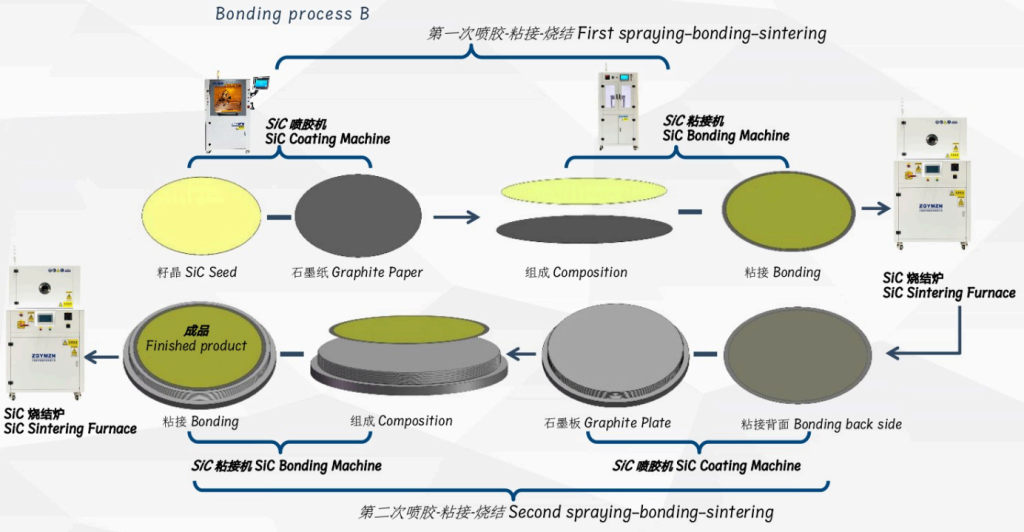
Overview of SiC Bonding Materials
SiC devices are commonly bonded using a variety of materials, including:
- Metallic bonding materials, such as silver pastes, copper alloys, or solders, which are typically selected for high thermal conductivity and electrical connectivity.
- Ceramic bonding materials, such as alumina or zirconia-based adhesives, used for electrical insulation and high-temperature structural connections.
- High-temperature epoxies or inorganic adhesives, primarily used in moderate temperature applications, protective coatings, or auxiliary structures.
When selecting a bonding material, key factors include thermal expansion compatibility, mechanical strength at operating temperatures, chemical stability, and the ability to maintain adhesion over time.
Thermal and Mechanical Challenges
High-temperature environments introduce several challenges for bonding materials:
- Thermal expansion mismatch: SiC has a low coefficient of thermal expansion, while most metals and ceramics have higher thermal expansion. Temperature cycling can generate internal stresses at the interface, leading to microcracking or delamination.
- Creep and stress relaxation: Metals and polymers can deform over time under constant stress at elevated temperatures, potentially reducing bond strength.
- Chemical stability: Oxidation, diffusion, or reaction with the SiC surface can degrade the interface, especially above 500°C in air or reactive atmospheres.
- Thermal cycling fatigue: Repeated heating and cooling cycles exacerbate stress accumulation and can initiate interfacial cracks, even if initial bonding strength is sufficient.
Understanding these mechanisms is essential to accurately predict the reliability and service life of SiC-bonded assemblies.
Failure Mechanisms of High-Temperature Bonds
The primary failure modes observed in SiC bonding materials include:
- Interfacial delamination: Separation occurs at the interface due to poor adhesion, thermal expansion mismatch, or chemical degradation.
- Creep-induced deformation: Metallic bonding layers may thin or flow under prolonged high-temperature stress, altering thermal and mechanical performance.
- Cracking in brittle adhesives: Ceramic or inorganic adhesives can crack under tensile or shear stress, especially in areas with stress concentration.
- Diffusion or chemical reactions: At high temperatures, elements from metals or fluxes can diffuse into SiC, forming brittle intermetallics or oxide layers that compromise mechanical integrity.
Identifying which failure mechanism is dominant under specific operating conditions is a key step in reliability assessment.
Methods for Reliability Assessment
Engineering reliability assessment of SiC bonding materials typically involves both experimental and analytical approaches:
- Mechanical testing at temperature, including shear, tensile, and peel tests to measure bond strength under operational conditions.
- Thermal cycling experiments to evaluate fatigue performance, simulating repeated heating and cooling cycles.
- Creep testing, particularly for metallic bonds, to assess long-term deformation under sustained load.
- Microstructural and chemical analysis, such as scanning electron microscopy and energy-dispersive spectroscopy, to detect interfacial degradation or chemical reactions.
- Finite element modeling, which allows simulation of stress distribution, thermal gradients, and predicted lifetime under combined thermal and mechanical loads.
A combination of these methods provides a robust evaluation of bond reliability and helps define safe operating conditions.
Lifetime Prediction Approaches
Predicting the service life of SiC bonds under high-temperature conditions can be approached using:
- Arrhenius-type models, where the rate of chemical degradation or diffusion is modeled as a function of temperature.
- Creep-fatigue models, integrating mechanical stress, temperature, and time to estimate failure probability.
- Coffin-Manson or Miner’s rule, for thermal cycling fatigue, estimating the number of cycles until crack initiation.
- Empirical testing correlations, derived from accelerated aging experiments, often used when detailed material constants are unavailable.
It is important to consider both the highest operating temperature and the thermal cycling profile, as even small fluctuations can significantly influence lifetime.
Design Considerations for High Reliability
To maximize the reliability of SiC bonds in high-temperature systems, engineers should:
- Carefully match the coefficient of thermal expansion between SiC and the bonding material to minimize interfacial stress.
- Choose adhesives or solders with proven high-temperature creep resistance and chemical stability.
- Optimize bond geometry to reduce stress concentrations, such as using fillets or graded bonding layers.
- Incorporate environmental protection, such as inert atmospheres or barrier coatings, to prevent oxidation or chemical attack.
- Validate designs through combined thermal, mechanical, and fatigue testing to ensure predicted lifetime aligns with operational requirements.
Case Studies and Industrial Applications
In power electronics modules, silver-based metallic bonds have demonstrated reliable performance at temperatures up to 300–400°C, provided thermal expansion is properly managed. In aerospace sensor windows or high-temperature reactors, ceramic bonding materials such as alumina adhesives maintain structural integrity up to 800°C but may require careful interface preparation and stress management to avoid cracking.
These examples highlight that material selection must be application-specific, considering both the operating temperature and the mechanical environment.
Conclusione
The reliability and lifetime of SiC bonding materials in high-temperature environments depend on thermal, mechanical, and chemical factors that interact in complex ways. Metallic, ceramic, and inorganic adhesive bonds each have advantages and limitations depending on temperature range, mechanical loading, and chemical exposure. Accurate assessment requires experimental testing, microstructural evaluation, and modeling to predict interfacial behavior over time. By carefully selecting materials, optimizing design, and validating through testing, engineers can ensure that SiC assemblies perform reliably and achieve their intended service life even under extreme high-temperature conditions.