


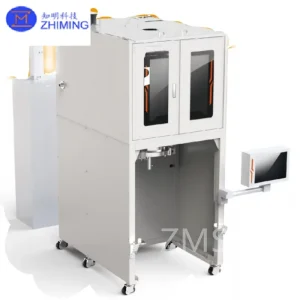
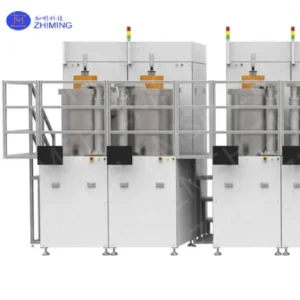
 The SiC crystal growth furnace is a critical piece of equipment for producing high-quality silicon carbide (SiC) single crystals used in power electronics, RF devices, and advanced semiconductor applications.
Our systems support multiple mainstream growth technologies, including:
-
Physical Vapor Transport (PVT)
-
Liquid Phase Epitaxy (LPE)
-
High-Temperature Chemical Vapor Deposition (HT-CVD)
With precise control of high temperature, vacuum, and gas flow, the furnace enables stable production of low-defect, high-purity SiC crystals in 4–6 inch sizes, with customization available for larger diameters.
Supported SiC Crystal Growth Methods
1. Physical Vapor Transport (PVT)
Process Principle: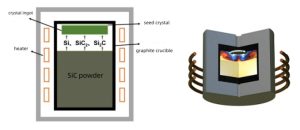 SiC powder is sublimated at temperatures above 2000°C. The vapor species are transported along a temperature gradient and recrystallized on a seed crystal.
Key Features:
-
High-purity graphite crucible and seed holder
-
Integrated thermocouple + infrared temperature monitoring
-
Vacuum and inert gas flow control system
-
PLC-based automatic process control
-
Cooling and exhaust gas treatment integration
Advantages:
-
Mature and widely adopted technology
-
Relatively low equipment cost
-
Suitable for bulk SiC crystal growth
Applications:
-
Production of semi-insulating and conductive SiC substrates
2. High-Temperature Chemical Vapor Deposition (HT-CVD)
 Process Principle:
High-purity gases (e.g., SiH₄ + C₂H₄ / C₃H₈) decompose at 1800–2300°C and deposit SiC onto the seed crystal.
Key Features:
-
Induction heating via electromagnetic coupling
-
Stable gas delivery system (He / H₂ carrier gases)
-
Controlled temperature gradient for crystal condensation
-
Precise doping capability
Advantages:
-
Low defect density
-
High crystal purity
-
Flexible doping control
Applications:
-
High-performance SiC wafers for advanced electronic devices
3. Liquid Phase Epitaxy (LPE)
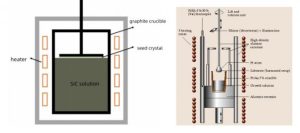 Process Principle:
Si and C dissolve in a high-temperature solution (~1800°C), and SiC crystallizes from a supersaturated melt during controlled cooling.
Key Features:
-
High-quality epitaxial layer growth
-
Low defect density and high purity
-
Relatively mild equipment requirements
-
Scalable for industrial production
Advantages:
-
Lower growth cost
-
Improved epitaxial layer quality
Applications:
-
Epitaxial layer growth on SiC substrates
-
Manufacturing of high-efficiency power devices
Technical Advantages
-
High-temperature operation (>2000°C)
-
Stable vacuum and gas flow control
-
Advanced PLC automation system
-
Customizable furnace design (size, configuration, process)
-
Compatible with 4–6 inch SiC crystal growth (expandable)
Our Capabilities
1. Equipment Supply
We provide fully engineered SiC crystal growth furnaces designed for:
-
High-purity semi-insulating SiC
-
Conductive SiC crystal production
-
Batch manufacturing requirements
2. Raw Materials & Crystal Supply
We supply:
-
SiC source materials
-
Seed crystals
-
Process consumables
All materials undergo strict quality inspection to ensure process stability.
3. Process Development & Optimization
Our engineering team supports:
-
Custom process development
-
Growth parameter optimization
-
Yield and crystal quality improvement
4. Training & Technical Support
We offer:
-
On-site / remote training
-
Equipment operation guidance
-
Maintenance and troubleshooting support
FAQ
Q1: What are the main SiC crystal growth methods?
A: The primary methods include PVT, HT-CVD, and LPE, each suitable for different applications and production goals.
Q2: What is liquid phase epitaxy (LPE)?
A: LPE is a solution-based growth method where a saturated melt is slowly cooled to drive crystal growth on a substrate, enabling high-quality epitaxial layers.
Why Choose Our SiC Growth Furnace?
-
Proven engineering experience in SiC equipment
-
Multi-method compatibility (PVT / HT-CVD / LPE)
-
Custom solutions for different production scales
-
Full lifecycle support (equipment + materials + process)
Reviews
There are no reviews yet.