
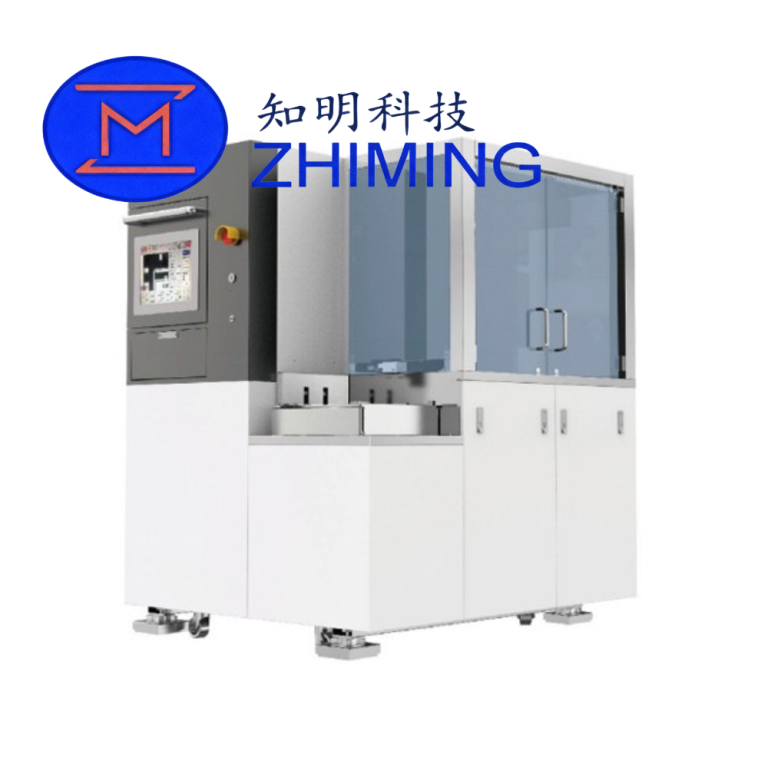
Wafer dicing is a critical back-end process in semiconductor manufacturing, where processed wafers are separated into individual dies. The choice of dicing equipment significantly influences yield, edge quality, and overall production efficiency. This article provides a comprehensive overview of maskin för tärning av wafers types, key system configurations, and practical selection criteria for different materials and applications.
1. Inledning
In modern semiconductor fabrication, wafers made of silicon, silicon carbide (SiC), sapphire, and glass must be precisely separated into functional chips without inducing damage. As device geometries shrink and materials become more advanced, the demands on dicing technology continue to increase.
A wafer dicing machine must achieve high precision, minimal chipping, and consistent throughput while maintaining compatibility with various materials and wafer sizes, including industry-standard 200 mm and 300 mm wafers. Selecting the appropriate dicing method is therefore essential for ensuring process reliability and cost efficiency.
2. Types of Wafer Dicing Machines
2.1 Blade Dicing Saw
Blade dicing is the most widely used and mature method in semiconductor manufacturing. It employs a high-speed rotating diamond blade to mechanically cut through the wafer along predefined scribe lines.
This method is particularly suitable for silicon wafers due to its high throughput and relatively low cost. Modern blade dicing systems can achieve high precision with optimized spindle speeds and advanced control systems.
However, mechanical contact introduces challenges such as edge chipping, micro-cracks, and tool wear. These issues become more pronounced when processing brittle or hard materials such as SiC and sapphire.
2.2 Laser Dicing
Laser dicing utilizes focused laser beams—ranging from nanosecond to femtosecond pulses—to remove material or induce internal modifications. Techniques such as stealth dicing enable separation without fully cutting through the wafer surface.
This method offers several advantages, including minimal mechanical stress, high precision, and the ability to process hard and brittle materials. It is especially effective for SiC, sapphire, and glass wafers where conventional blade dicing may cause damage.
Despite its advantages, laser dicing systems typically involve higher capital investment and may have lower throughput for thicker wafers. Process optimization is also more complex, requiring precise control of laser parameters.
2.3 Diamond Wire Saw
Diamond wire sawing is commonly used for slicing rather than final dicing, but it plays an important role in wafer preparation and certain specialized applications. A diamond-coated wire moves at high speed to cut through the material with relatively low mechanical stress.
This method is well suited for hard materials and offers improved surface quality compared to traditional mechanical cutting. However, it generally provides lower precision than blade or laser dicing and is less commonly used for fine die separation.
3. Key Machine Configurations
The performance of a wafer dicing machine is determined not only by the cutting method but also by its internal system configuration.
3.1 Spindle System
The spindle is a core component in blade dicing machines. High-speed spindles, often exceeding 30,000 rpm, ensure stable cutting and high precision. Vibration control and thermal stability are critical factors influencing cutting quality.
3.2 Motion Control System
Advanced motion systems use linear motors and air-bearing stages to achieve sub-micron positioning accuracy. Precise motion control is essential for maintaining alignment with narrow scribe lines, especially in high-density integrated circuits.
3.3 Vision Alignment System
Modern dicing machines are equipped with high-resolution vision systems that align the cutting path with wafer patterns. This ensures accurate positioning and reduces the risk of cutting errors, which is crucial for maximizing yield.
3.4 Cooling and Debris Removal
During blade dicing, cooling systems are used to dissipate heat and prevent thermal damage. Simultaneously, cleaning systems remove particles and debris generated during cutting, maintaining a clean processing environment.
3.5 Automation and Handling Systems
Automation plays a key role in high-volume manufacturing. Wafer handling systems enable automatic loading, unloading, and transfer between processes. Integration with factory automation systems improves efficiency and reduces human error.
4. Selection Criteria for Wafer Dicing Machines
Choosing the appropriate wafer dicing machine requires a comprehensive evaluation of several factors.
4.1 Material Properties
Different materials require different dicing methods:
- Silicon: Blade dicing is generally sufficient
- Silicon carbide (SiC): Laser or wire-based methods are preferred
- Sapphire: Laser dicing is often the best option
- Glass: Both laser and blade methods may be used depending on thickness
Material hardness, brittleness, and thermal properties all influence the selection.
4.2 Wafer Size
As the industry transitions to larger wafers, particularly 300 mm, equipment must provide higher rigidity, precision, and automation capabilities. Larger wafers also demand better process control to maintain uniformity across the entire surface.
4.3 Precision Requirements
Key precision metrics include:
- Kerf width (cutting street width)
- Edge chipping size
- Surface roughness
Applications such as MEMS and optoelectronics often require extremely tight tolerances, making laser dicing more suitable.
4.4 Throughput and Cost Considerations
There is always a trade-off between throughput and cost:
- Blade dicing offers high throughput and lower cost
- Laser dicing provides superior quality but at higher cost
- Wire sawing offers a balance for certain applications
Manufacturers must align equipment selection with production volume and budget constraints.
4.5 Application Requirements
Different applications impose different requirements:
- Power electronics: often involve SiC and require low-damage processing
- MEMS devices: require high precision and minimal contamination
- Optoelectronic devices: demand excellent surface quality and transparency
5. Industry Trends and Future Developments
The evolution of semiconductor materials and device architectures is driving innovation in wafer dicing technology.
Laser-based dicing is gaining increasing importance due to its ability to process advanced materials with minimal damage. At the same time, hybrid systems combining mechanical and laser techniques are emerging to optimize both efficiency and quality.
Automation and intelligent process control are also becoming standard features. Machine learning algorithms are being explored to optimize cutting parameters in real time, improving yield and consistency.
Additionally, the push toward ultra-thin wafers and heterogeneous integration is creating new challenges for dicing processes, requiring even greater precision and process control.
6. Slutsatser
Wafer dicing is a crucial step that directly affects the performance and yield of semiconductor devices. The selection of an appropriate dicing machine depends on a combination of factors, including material type, wafer size, precision requirements, and production volume.
While blade dicing remains the dominant technology for silicon wafers, laser dicing is becoming increasingly important for advanced materials such as SiC and sapphire. Diamond wire sawing continues to play a supporting role in specific applications.
Ultimately, achieving optimal results requires not only selecting the right equipment but also carefully optimizing process parameters and system configurations. As semiconductor technology continues to evolve, wafer dicing solutions will play an increasingly vital role in enabling next-generation devices.