
Purchasing semiconductor process equipment is not simply a matter of confirming that a machine powers on and meets a basic specification sheet. For wafer fabs, research institutes, pilot lines, advanced packaging facilities, and semiconductor material manufacturers, equipment qualification must demonstrate that the system can repeatedly deliver the required process results under real production conditions.
A proper qualification program normally includes Factory Acceptance Testing (FAT), Site Acceptance Testing (SAT), process window validation, uptime evaluation, preventive maintenance planning, and spare parts verification.
These steps are especially important for equipment used in wafer processing, thin-film deposition, plasma etching, cleaning, thermal processing, polishing, inspection, crystal processing, and advanced packaging.
This guide explains the key items buyers should review before approving semiconductor process equipment for production.
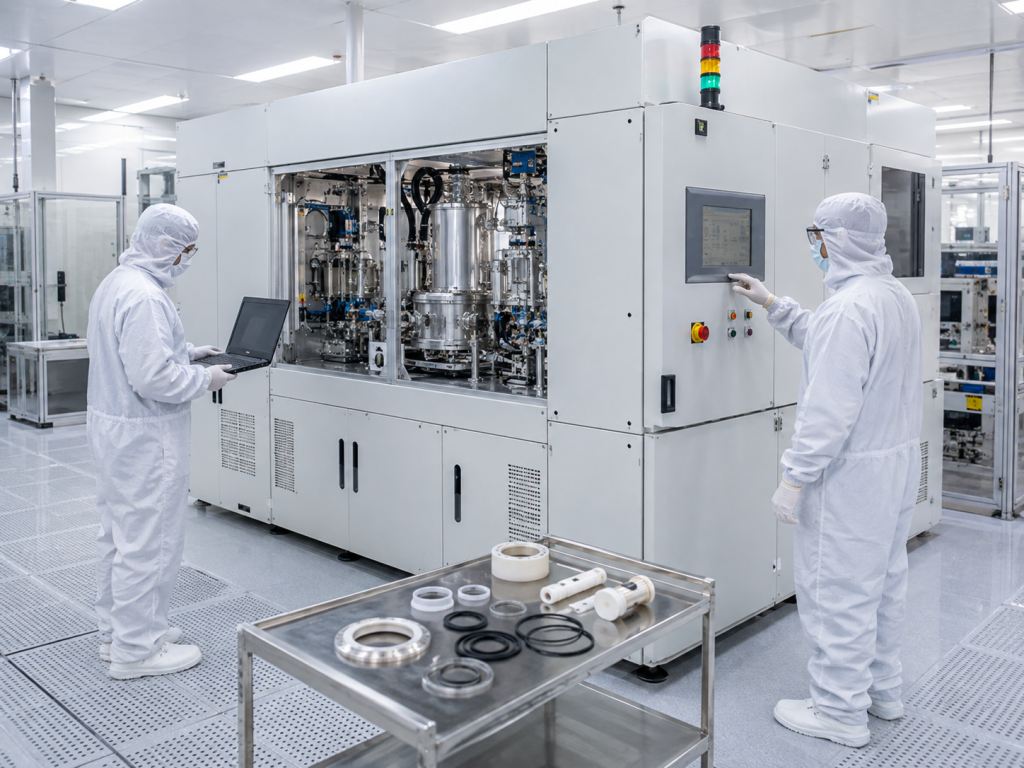
1. Start With a Clear User Requirement Specification
Before FAT or SAT begins, the buyer should define a detailed User Requirement Specification, commonly called a URS.
The URS becomes the reference document for equipment design, acceptance testing, and final qualification.
Typical requirements include:
- Wafer diameter and substrate type
- Maximum wafer thickness range
- Process temperature range
- Pressure or vacuum range
- Gas flow requirements
- Chamber materials
- Process uniformity
- Particle requirements
- Throughput
- Equipment uptime
- Automation level
- Recipe management
- Data logging
- Safety interlocks
- Facility requirements
- Preventive maintenance intervals
- Spare parts support
For example, purchasing a deposition system based only on a statement such as “compatible with 200 mm wafers” is insufficient.
The buyer may also need to define:
- Film thickness target
- Within-wafer uniformity
- Wafer-to-wafer repeatability
- Deposition rate
- Maximum particle increase
- Process temperature stability
- Chamber recovery time
- Lot throughput
A clearly defined URS prevents disputes during FAT and SAT.
2. What Is FAT in Semiconductor Equipment Qualification?
Factory Acceptance Testing (FAT) is performed at the equipment manufacturer’s facility before shipment.
The main objective is to confirm that the equipment has been manufactured according to the agreed specifications and can perform its required functions before it is transported to the customer’s factory.
FAT should normally evaluate three areas:
Mechanical Qualification
Mechanical inspection may include:
- Equipment dimensions
- Chamber construction
- Wafer handling mechanisms
- Robot movement
- Load locks
- Pumps
- Gas lines
- Cooling systems
- Electrical cabinets
- Utility connections
Critical dimensions and interface locations should match the approved equipment drawing.
Electrical and Software Qualification
The buyer should confirm:
- Power requirements
- PLC operation
- HMI functions
- Recipe storage
- User access control
- Alarm functions
- Safety interlocks
- Emergency stop operation
- Data logging
- Communication interfaces
Where equipment will be connected to factory automation, communication protocols should also be tested.
Examples include:
- SECS/GEM
- Ethernet
- OPC
- MES interfaces
- Equipment monitoring systems
Basic Process Performance
Whenever possible, FAT should include actual process runs using representative wafers or substrates.
Depending on the equipment, FAT may evaluate:
- Temperature stability
- Vacuum performance
- Gas flow stability
- Deposition rate
- Etch rate
- Cleaning efficiency
- Film thickness
- Surface roughness
- Particle performance
- Wafer handling accuracy
The FAT report should clearly record test methods, acceptance criteria, measured values, and any unresolved deviations.
3. FAT Checklist for Semiconductor Equipment Buyers
A practical FAT checklist may include the following categories.
Equipment Configuration
Confirm:
- Model number
- Serial number
- Chamber configuration
- Installed options
- Pump models
- Mass flow controller ranges
- Heater specifications
- Wafer handling configuration
- Software version
Every installed configuration should match the purchase order.
Utility Verification
Check required utilities such as:
- Electrical power
- Compressed air
- Cooling water
- Process gases
- Nitrogen
- Vacuum
- Exhaust
Unexpected utility requirements discovered after delivery can delay installation significantly.
Safety Verification
Important checks include:
- Emergency stop
- Door interlock
- Gas alarm
- Over-temperature protection
- Vacuum failure alarm
- Cooling water failure protection
- Pressure limits
Safety qualification should never be treated as a simple documentation exercise.
4. What Is SAT?
Site Acceptance Testing (SAT) is performed after the equipment has been delivered, installed, and connected to utilities at the customer’s site.
FAT proves the machine worked at the supplier’s factory.
SAT proves that it works correctly under the customer’s actual production conditions.
Installation can introduce new variables, including:
- Facility power quality
- Cooling water temperature
- Gas pressure
- Exhaust performance
- Floor vibration
- Cleanroom conditions
- Communication networks
Therefore, equipment that passed FAT should still complete SAT before being released for production.
5. Key SAT Qualification Items
SAT typically begins with installation verification.
Utility Confirmation
Verify actual operating values for:
- Power
- Cooling water
- CDA
- Nitrogen
- Process gases
- Vacuum
- Exhaust
These should be compared with the supplier’s facility specification.
Wafer Handling
For automated systems, verify:
- Cassette loading
- FOUP loading
- Wafer mapping
- Alignment
- Robot transfer
- Chamber loading
- Wafer unloading
The system should operate without wafer slipping, edge contact, excessive vibration, or abnormal handling errors.
Alarm and Interlock Testing
Each critical alarm should be intentionally triggered and verified.
Examples include:
- Cooling water interruption
- Low gas pressure
- Vacuum failure
- Door opening
- Over-temperature
- Process timeout
Process Verification
The same or similar process used during FAT should be repeated.
Results should be compared with FAT data to confirm that installation has not significantly changed equipment performance.
6. Qualifying the Process Window
Passing FAT and SAT does not automatically mean that equipment is production-ready.
The next major step is process window qualification.
A process window defines the range of operating parameters within which the equipment consistently produces acceptable results.
Depending on the process, parameters may include:
- Temperature
- Pressure
- RF power
- Gas flow
- Process time
- Chamber pressure
- Rotation speed
- Chemical concentration
- Plasma power
- Wafer spacing
Instead of testing only one ideal recipe, engineers should deliberately test parameter combinations around the target recipe.
For example, a nominal deposition process may use:
- Temperature: 400°C
- Pressure: 3 Torr
- Gas flow: 100 sccm
Qualification may also test controlled variations around these values.
This helps determine whether the process is robust or extremely sensitive to small equipment variations.
7. Process Capability Is More Important Than One Successful Run
One good wafer does not demonstrate production capability.
Semiconductor equipment should demonstrate repeatability across multiple:
- Wafers
- Lots
- Chambers
- Days
- Operators
Useful indicators may include:
- Wafer-to-wafer uniformity
- Lot-to-lot repeatability
- Run-to-run drift
- Chamber matching
- Particle stability
- Equipment recovery after maintenance
Statistical Process Control can also be introduced during qualification.
For measurable characteristics, buyers may establish:
- Mean value
- Standard deviation
- Control limits
- Cp
- Cpk
These metrics provide a much better indication of long-term manufacturing capability than a single acceptance test.
8. Evaluate Equipment Uptime
A machine can meet process specifications but still be unsuitable for production if it stops too frequently.
Therefore, uptime and availability should be included in equipment qualification.
Important metrics include:
Availability
Availability can be calculated as:
Availability = Operating Time / Planned Production Time
For production equipment, the expected target should be agreed before purchase.
MTBF
Mean Time Between Failures indicates how frequently equipment failures occur.
Higher MTBF generally means better reliability.
MTTR
Mean Time To Repair measures how quickly equipment can be restored after a failure.
A system with moderate failure frequency may still achieve good availability if maintenance and spare parts replacement are fast.
9. Perform an Extended Reliability Run
Where practical, semiconductor buyers should perform an extended production simulation before final acceptance.
For example:
- Continuous operation for 24 hours
- Multiple production lots
- Repeated wafer transfer cycles
- Process runs without engineering intervention
The exact duration depends on the equipment.
During the reliability run, record:
- Number of wafers processed
- Equipment stops
- Alarm frequency
- Robot errors
- Process failures
- Maintenance events
- Unscheduled downtime
Minor problems that do not appear during a short FAT test often become obvious during extended operation.
10. Understand Preventive Maintenance Requirements
Preventive maintenance has a major impact on semiconductor equipment ownership cost.
Before purchasing equipment, buyers should request a detailed PM schedule.
Typical maintenance items may include:
- Chamber cleaning
- O-ring replacement
- Pump maintenance
- Filter replacement
- Electrode replacement
- Heater inspection
- Robot lubrication
- Sensor calibration
- MFC calibration
Ask the supplier to specify maintenance intervals by:
- Operating hours
- Wafer count
- Process cycles
- Calendar time
Maintenance duration should also be evaluated.
A chamber requiring frequent eight-hour cleaning cycles may have significantly lower effective throughput than the nominal equipment specification suggests.
11. Spare Parts Are Part of Equipment Qualification
Spare parts planning is often overlooked during equipment purchasing.
However, a relatively inexpensive component can stop a production line for several days if it is unavailable.
Critical spare parts may include:
- O-rings
- Quartz components
- Ceramic parts
- SiC components
- Heaters
- Thermocouples
- Vacuum gauges
- MFCs
- RF components
- Pumps
- Valves
- Robot sensors
- Filters
- Seals
Buyers should classify spare parts according to their impact on production.
Level A: Production-Stopping Parts
Failure causes immediate equipment downtime.
These parts should normally be stocked locally.
Level B: High-Wear Components
Parts replaced regularly during preventive maintenance.
Stock levels should be based on maintenance frequency.
Level C: Low-Failure Components
These may be ordered when required, assuming reasonable supplier lead time.
12. Ask About Spare Parts Lead Time
A spare parts list is useful only when lead time is known.
For each critical component, ask:
- Manufacturer
- Part number
- Expected lifetime
- Recommended stock quantity
- Unit price
- Normal lead time
- Emergency lead time
Some semiconductor equipment components may have significantly longer lead times than expected.
If a single component requires several weeks or months for replacement, stocking it locally may be justified.
13. Verify Consumable Material Specifications
Many semiconductor process tools use consumable parts made from specialized materials.
Examples include:
- Fused quartz
- High-purity alumina
- Aluminum nitride
- Silicon carbide
- CVD SiC
- Silicon
- Sapphire
- Graphite
These materials can influence:
- Particle generation
- Contamination
- Plasma stability
- Temperature uniformity
- Equipment lifetime
The buyer should request specifications for critical consumables rather than accepting generic descriptions such as “high purity quartz.”
Important information may include:
- Material grade
- Purity
- Manufacturing process
- Surface finish
- Dimensional tolerance
- Cleaning method
- Packaging
- Inspection report
This becomes particularly important when sourcing replacement consumables from alternative suppliers.
14. Confirm Documentation Before Final Acceptance
A semiconductor process equipment package should normally include comprehensive technical documentation.
Typical documents include:
- Equipment manual
- Installation manual
- Electrical drawings
- Gas diagrams
- Cooling water diagrams
- Vacuum diagrams
- Spare parts list
- Preventive maintenance schedule
- Calibration procedures
- Safety documentation
- Software backup
- FAT report
- SAT report
Where applicable, calibration certificates should also be provided for important sensors and measurement devices.
15. Technician and Operator Training
Equipment qualification should include personnel training.
Different training levels may be required for:
Operators
Training should cover:
- Loading wafers
- Selecting recipes
- Starting processes
- Responding to alarms
- Basic troubleshooting
Process Engineers
Training may include:
- Recipe development
- Process optimization
- Parameter limits
- Data analysis
Maintenance Engineers
Training should cover:
- Preventive maintenance
- Component replacement
- Calibration
- Troubleshooting
- Diagnostic software
A technically capable maintenance team can significantly reduce MTTR and improve equipment uptime.
16. Recommended Semiconductor Equipment Qualification Flow
A practical qualification sequence is:
Step 1: Define the URS.
Step 2: Review equipment configuration and specifications.
Step 3: Perform FAT at the supplier’s facility.
Step 4: Close FAT deviations before shipment.
Step 5: Install equipment at the customer’s site.
Step 6: Perform SAT.
Step 7: Verify baseline process performance.
Step 8: Establish the process window.
Step 9: Run repeatability and reliability tests.
Step 10: Review preventive maintenance requirements.
Step 11: Establish critical spare parts inventory.
Step 12: Complete operator and engineering training.
Step 13: Approve the equipment for production.
17. Semiconductor Equipment RFQ Checklist
Before ordering semiconductor equipment, buyers should consider asking suppliers to provide the following information:
- Supported wafer sizes
- Substrate compatibility
- Process capability
- Uniformity specification
- Repeatability specification
- Throughput
- Facility requirements
- FAT protocol
- SAT protocol
- Reliability data
- Uptime target
- MTBF
- MTTR
- Preventive maintenance schedule
- Consumable lifetime
- Recommended spare parts
- Spare parts lead time
- Software support
- Technical service locations
- Training program
- Warranty conditions
For custom semiconductor equipment, these items should ideally be agreed before the purchase order is finalized.
Conclusion
Semiconductor equipment qualification should evaluate much more than whether a machine meets its basic mechanical specifications.
A reliable qualification program combines FAT, SAT, process window validation, repeatability testing, uptime analysis, preventive maintenance planning, and spare parts management.
FAT confirms that the system was manufactured according to specification. SAT confirms that it operates correctly in the customer’s facility. Process window testing determines whether the system can maintain acceptable results across normal operating variations.
Finally, uptime, maintenance requirements, consumable life, and spare parts availability determine whether the equipment can support continuous production.
For semiconductor manufacturers, these factors directly affect yield, production capacity, maintenance cost, and the long-term total cost of ownership.
FAQ
What is the difference between FAT and SAT for semiconductor equipment?
FAT is performed at the equipment manufacturer’s facility before shipment, while SAT is performed after installation at the customer’s production site. FAT verifies equipment construction and baseline functionality, while SAT confirms performance under the customer’s actual facility and process conditions.
How many wafers should be used for equipment qualification?
There is no universal number. The quantity depends on the equipment type, process risk, production volume, and customer requirements. Production equipment normally requires multiple wafers and multiple lots to evaluate repeatability, drift, and reliability rather than relying on a single successful process run.
Why is process window qualification important?
A semiconductor process must remain stable even when operating parameters vary slightly. Process window qualification identifies the acceptable operating range for temperature, pressure, gas flow, power, time, or other variables and helps determine whether a process is robust enough for production.
Which spare parts should semiconductor fabs keep in stock?
Components that can immediately stop production, have high replacement frequency, or have long supplier lead times should normally receive the highest stocking priority. Typical examples include seals, sensors, valves, heaters, vacuum components, quartz parts, ceramic parts, and other process chamber consumables.
What should be reviewed before final equipment acceptance?
Final acceptance should normally confirm SAT results, process capability, repeatability, reliability, safety systems, documentation, training, preventive maintenance requirements, spare parts availability, and closure of all outstanding FAT or SAT issues.