
In semiconductor manufacturing, drilling is often perceived as a simple geometric operation. However, once the feature size enters the micrometer scale, hole fabrication becomes a multidisciplinary challenge involving material science, energy transfer, and process stability. Laser drilling and mechanical machining represent two fundamentally different technological approaches to micro-hole processing.
The real question is not which method is more advanced, but rather: are we removing material through mechanical interaction, or transforming it through concentrated energy input?
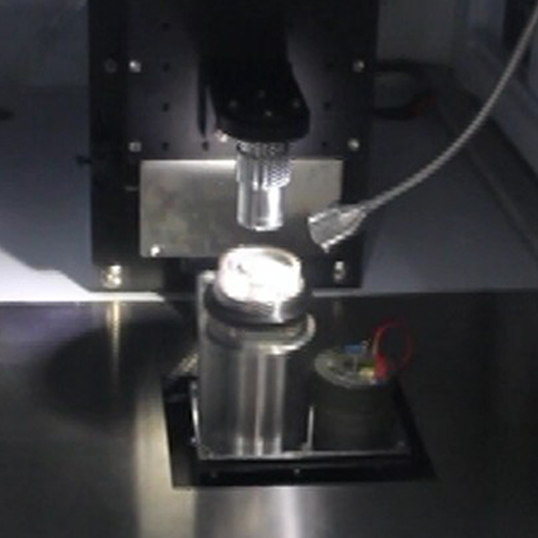
The Fundamental Nature of Micro-Hole Processing
At its core, any drilling process forces a localized material failure. The difference lies in how that failure is initiated and controlled.
Mechanical machining is governed by contact mechanics. Cutting tools apply localized stress to exceed the material’s shear or fracture strength, leading to material removal through crack initiation and propagation. Energy is transferred primarily in mechanical form, and the affected zone experiences continuous stress fields. This makes mechanical processes predictable and controllable, but also inherently sensitive to material hardness, brittleness, and anisotropy.
Laser drilling, by contrast, relies on extremely high energy density delivered over very short time scales. Optical energy is converted into thermal energy, rapidly driving the material through melting, vaporization, or even plasma formation. Material is expelled rather than cut. This non-contact mechanism enables efficient processing of ultra-hard and brittle materials such as silicon carbide, sapphire, and advanced ceramics, while introducing thermal effects that must be carefully managed.
Scaling Effects at the Micrometer Level
As hole diameter decreases, processing difficulty does not increase linearly. Instead, it escalates dramatically.
In mechanical machining, tool geometry becomes a limiting factor. Micro-scale drills suffer from reduced stiffness, increased wear, and amplified runout. Even minor deviations can lead to severe geometric errors or catastrophic tool failure. For brittle semiconductor materials, localized stress concentrations often result in chipping and micro-crack formation around the hole entrance.
Laser drilling eliminates tool size constraints, but introduces a different challenge: energy control. Insufficient energy fails to achieve penetration, while excessive energy causes melt redeposition, micro-cracking, or undesired material phase transformations. The process window is defined not by geometry, but by pulse duration, fluence, repetition rate, and beam quality.
Redefining Hole Quality Beyond Geometry
In semiconductor applications, a hole is rarely judged by its diameter alone.
Geometric quality includes circularity, taper angle, and dimensional consistency across large arrays. Mechanical machining often excels in single-hole precision, while laser drilling offers superior repeatability in high-density hole patterns through automated beam control.
More critical, however, is material integrity. Subsurface micro-cracks, residual stress, and phase modification along the hole wall can directly affect electrical insulation, thermal performance, and long-term reliability of devices. Non-contact processing does not imply damage-free processing, and mechanical precision does not guarantee material stability.
Process Selection as a Design Problem
In advanced semiconductor manufacturing, the choice is rarely binary. Increasingly, hybrid process strategies are adopted.
Laser drilling may be used for rapid material removal, followed by mechanical or chemical finishing to refine surface quality. Mechanical pre-drilling can reduce laser energy requirements, minimizing thermal effects. Post-processing steps such as annealing are often employed to relieve residual stresses introduced during laser processing.
These combined approaches reflect a deeper understanding that micro-hole fabrication is not a single step, but a carefully designed process chain.
Conclusion: Technology Must Respect the Material
The distinction between laser drilling and mechanical machining is not a matter of modern versus traditional technology. It is a difference in how each method interacts with matter.
Mechanical machining forces the material to yield through applied stress. Laser drilling induces transformation through localized energy concentration. High-quality semiconductor micro-hole processing emerges when material behavior, energy input, and process stability are balanced within a narrow and well-understood window.